Why “impact-grade” adapters keep shearing off in the gun — and the one difference that decides whether an adapter survives or snaps.
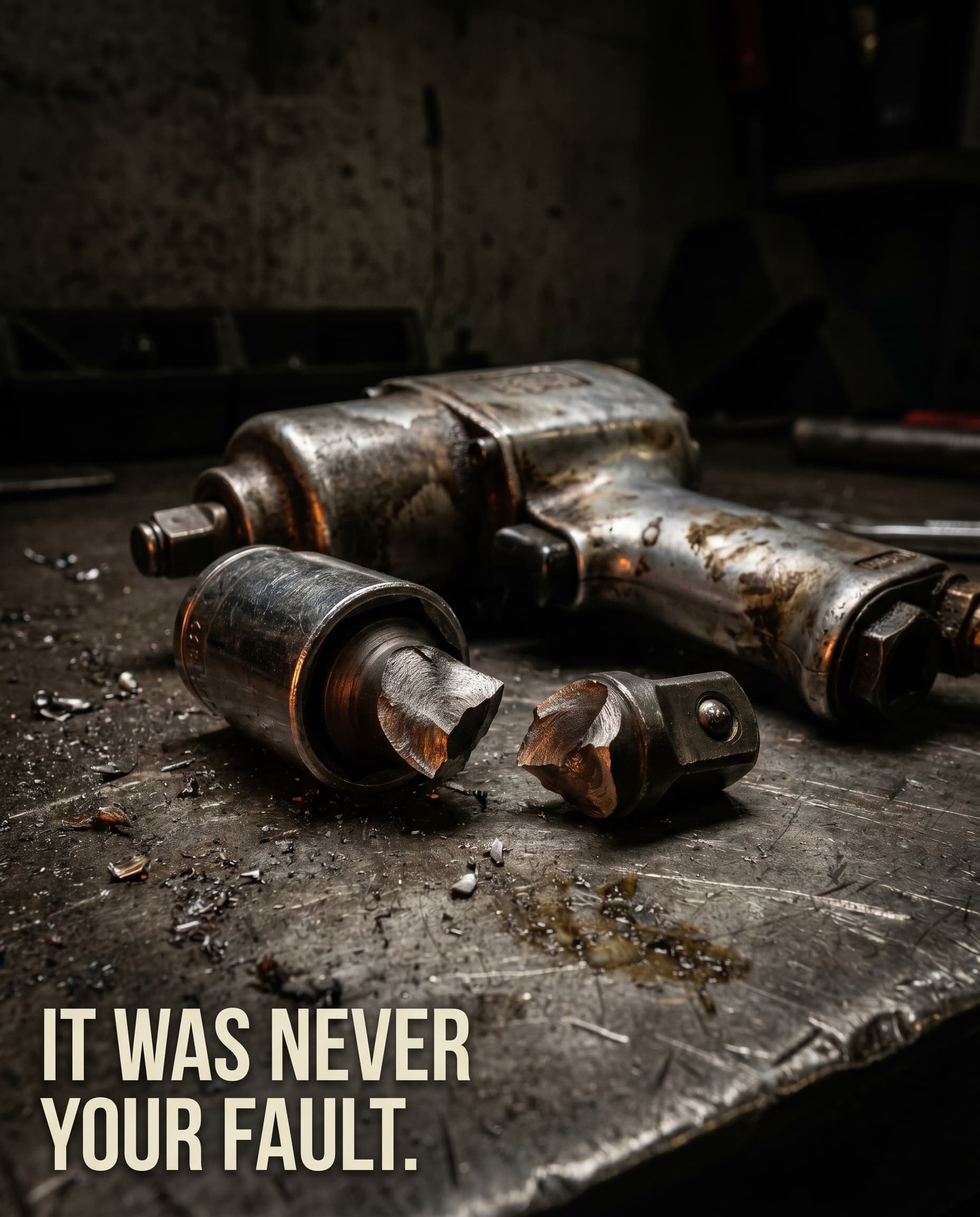
The adapter was the weak link. Not you.
Nobody tells you the truth about adapters.
Not the box. Not the listing. The box says “impact grade.” It says “hardened steel,” “heavy duty,” and you believe it — why wouldn’t you. Then you put it on the gun, lean into a seized bolt, and crack. It shears off flush. Half of it’s still buried in the socket, the other half spinning on your anvil.
So you buy another one. Different brand this time. Snaps the same way. You’ve been through the Dewalt, the Kobalt, the Amazon special, the one the guy at the counter swore by. You’ve left more dead adapters in the bottom of your box than you can count — and dropped more sockets into the engine bay than you’d care to admit.
And somewhere in there, you start to wonder if it’s you. Maybe your gun’s too much. Maybe you’re just not supposed to run an adapter on an impact at all.
It isn’t you. It isn’t your gun.
Here’s what the box will never tell you: most adapters are made the cheap way — cast or rough-cut from soft steel instead of forged and properly hardened from real chrome-vanadium — and then quietly rated for a fraction of what your impact actually delivers. Your gun hammers out hundreds of foot-pounds in sharp, repeated blows. That cheap little cross-section was never built to pass them through. So it does the only thing soft, under-rated steel can do under that kind of load.
It becomes the sacrificial weak link. And it shears.
That’s the part worth sitting with: the cheap adapter doesn’t break because you did something wrong. It breaks because it was built to break. Every “impact-grade” set that ever let you down failed for the same hidden reason — wrong steel, rated below your tool — and not one of those failures was on you.
And it’s not just the snapping. The same cheap build is why the thing never fit the spot you actually needed it for — all that wasted length holding the socket an inch too far off the tool, so you’re fighting to reach a bolt your hand already can’t get to. It’s why the socket dropped off mid-pull and vanished into the bay. Soft steel, sloppy tolerances, a magnet that quit holding after a week.
So you did what everyone does. You bought cheaper, and it snapped. You bought a full set of sockets in every drive size, and now you’re hauling around forty pounds of steel and still can’t fit the tight spot. Somebody told you to just buy a bigger impact — but you’ve already got the gun; that was never the problem, and a stronger gun only snaps a cheap adapter faster.
Nothing actually does the one thing you want: convert the drive, reach the spot, and survive the gun — every time, without becoming the part that fails.
So here’s the thing worth saying plainly, tech to tech:
Tell an old hand you run adapters on your impact and he’ll wince. And he’s not wrong — about the adapters he’s picturing. That warning exists for a reason: cheap, under-rated adapters snap, and a soft little step-up on a big gun is being asked to do a job it was never built for. He’s right. The advice is just aimed at the wrong thing. It’s not the laws of physics telling you an adapter can’t take an impact. It’s the cheap steel.
Forge it from the right alloy. Rate it past what your gun delivers. Size it so it’s the strongest part of the setup instead of the weakest. And that old rule simply stops applying.
I didn’t set out to start a tool company. I set out to stop snapping adapters. I spent years under the gun and burned through every brand in the box — watched the techs around me do the exact same thing — and got sick of cursing the whole drawer of them. So I went looking for the one set that was actually built right: genuinely forged chrome-vanadium instead of cast, low enough in profile to reach the spots that were killing us, with a magnet that actually held the socket.
When I finally found the set that survived everything I threw at it, I put my name on it. That’s what Aurisle is — not one more “impact-grade” sticker slapped on the same soft steel, but the one set I’d already beaten on, so you don’t have to snap your way through the same dozen I did to get here.
Here’s exactly why it survives the gun — and what we did to prove it.
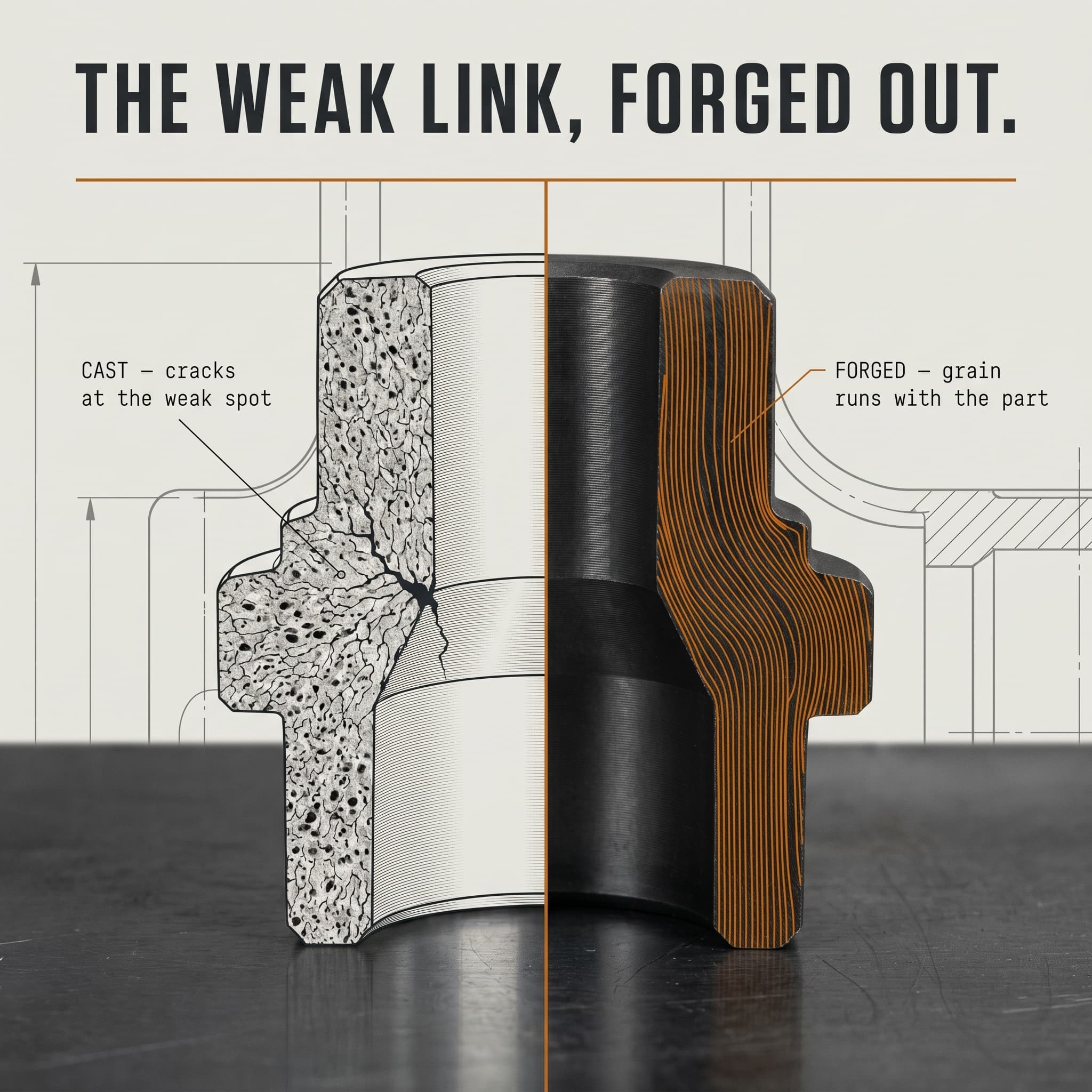
Cast steel gets poured into a mold. The grain runs every which way, and wherever the grain runs wrong, that’s where it cracks. Forging is the opposite — the chrome-vanadium gets hammered into shape under pressure, so the grain runs with the part instead of against it. Then it’s heat-treated and hardened so it takes the hammering and holds, instead of finding a weak spot and letting go.
In shop terms: when your gun hammers, a forged adapter passes the blow through and holds. A cast one finds its weakest spot and gives up.
That’s the whole difference between an adapter that’s the weak link and one that’s the strongest thing on your gun.
Forged to take the hit. Not cast to fail.
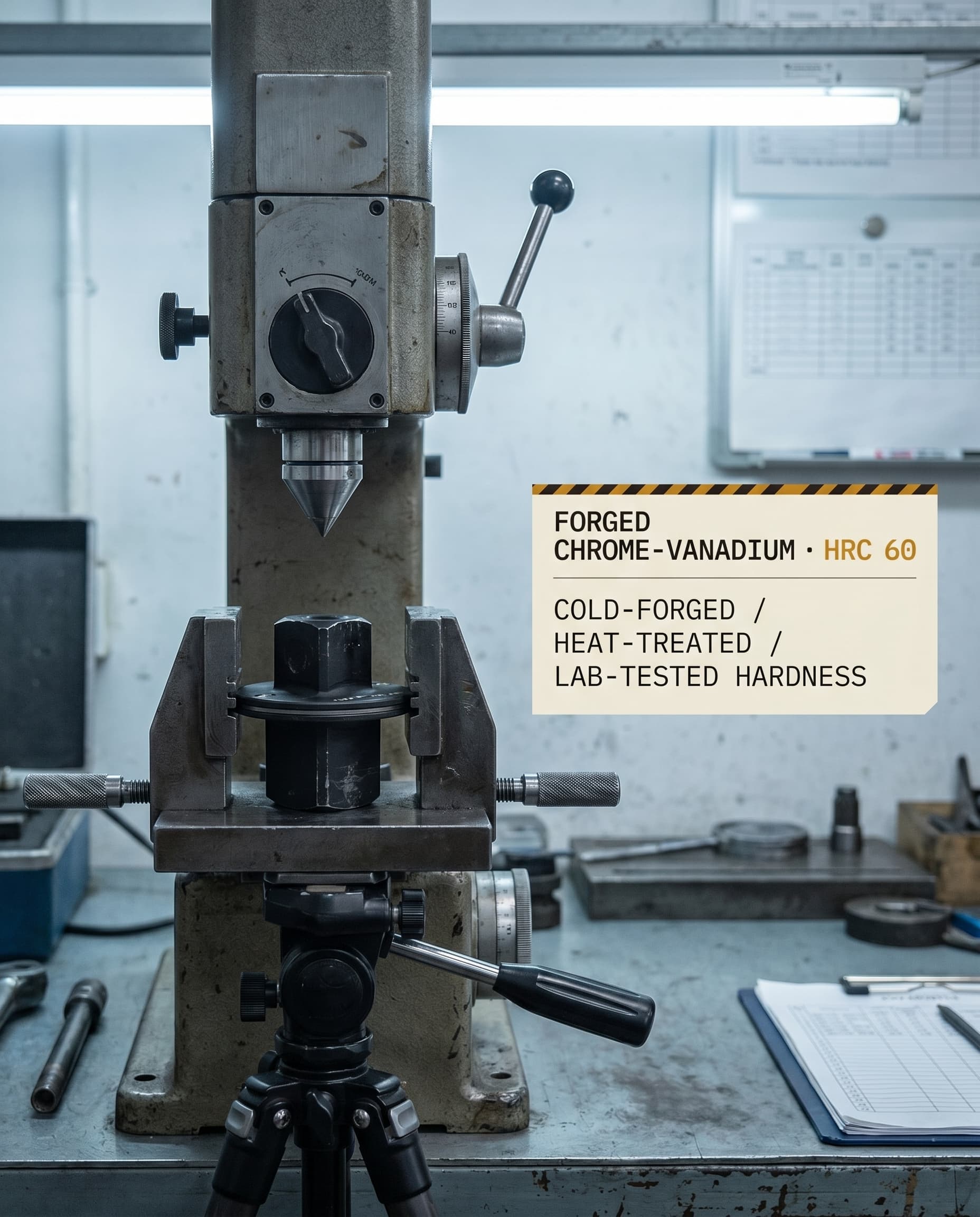
Talk is cheap, and you’ve been burned by it before. So here’s the spec in black and white — the stuff that actually decides whether an adapter survives the gun or shears off in it.
That’s the difference on paper: forged, hardness-tested Cr-V instead of the soft, cast steel that snaps. But you’ve read a spec sheet before — so paper isn’t where this gets settled. Keep going.
Forged Cr-V. Hardened to HRC 60. Built not to deform.
You’ve read “heavy-duty” on every box you ever snapped, so we’re not going to just say it louder. Here’s what you can check for yourself: the steel is forged, hardened, and lab-tested to HRC 60 — the spec right above this — so the part that used to be the weak link is finally pulling its weight. The rest, you settle on your own terms.
That’s the standard: the adapter being the strongest part of your setup instead of the weakest. We’re not asking you to take our word for it — we’re handing you the test.
Here’s the other half of why your old adapters let you down: all that wasted length holding the socket an inch too far off the tool, so you couldn’t fit the spot the bolt was actually in.
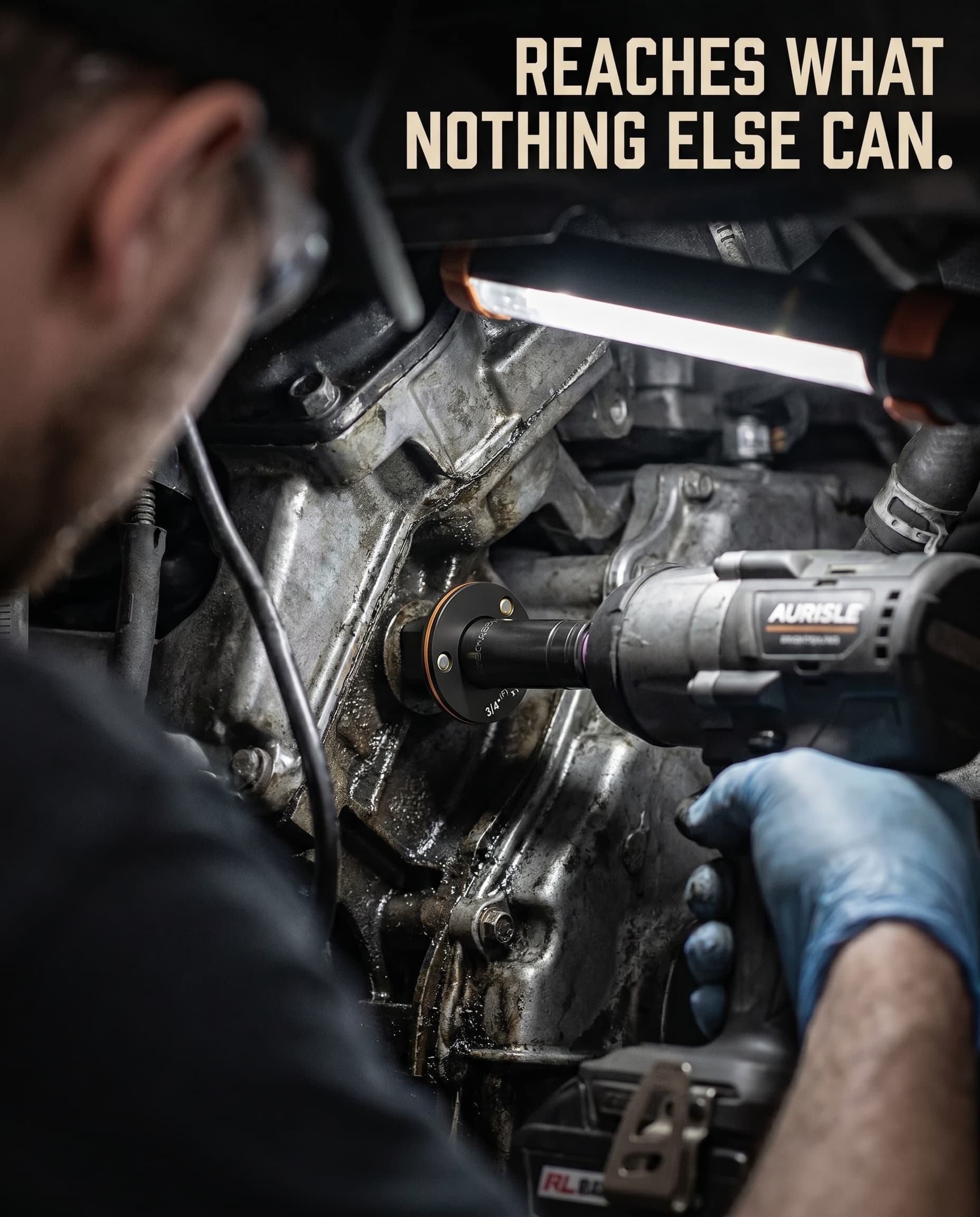
This one’s built stubby — an ultra-slim profile that adds barely any height to your tool — so the socket sits tight to the gun and gets into the cramped, low-clearance spots where standard adapters fail and your hand barely reaches.
The socket sits where your hand can’t.
You know the move: you’re reaching overhead or into a blind hole, the socket slips off the end, and now you’re fishing it out of the bay — or hunting the floor for a dropped pin.
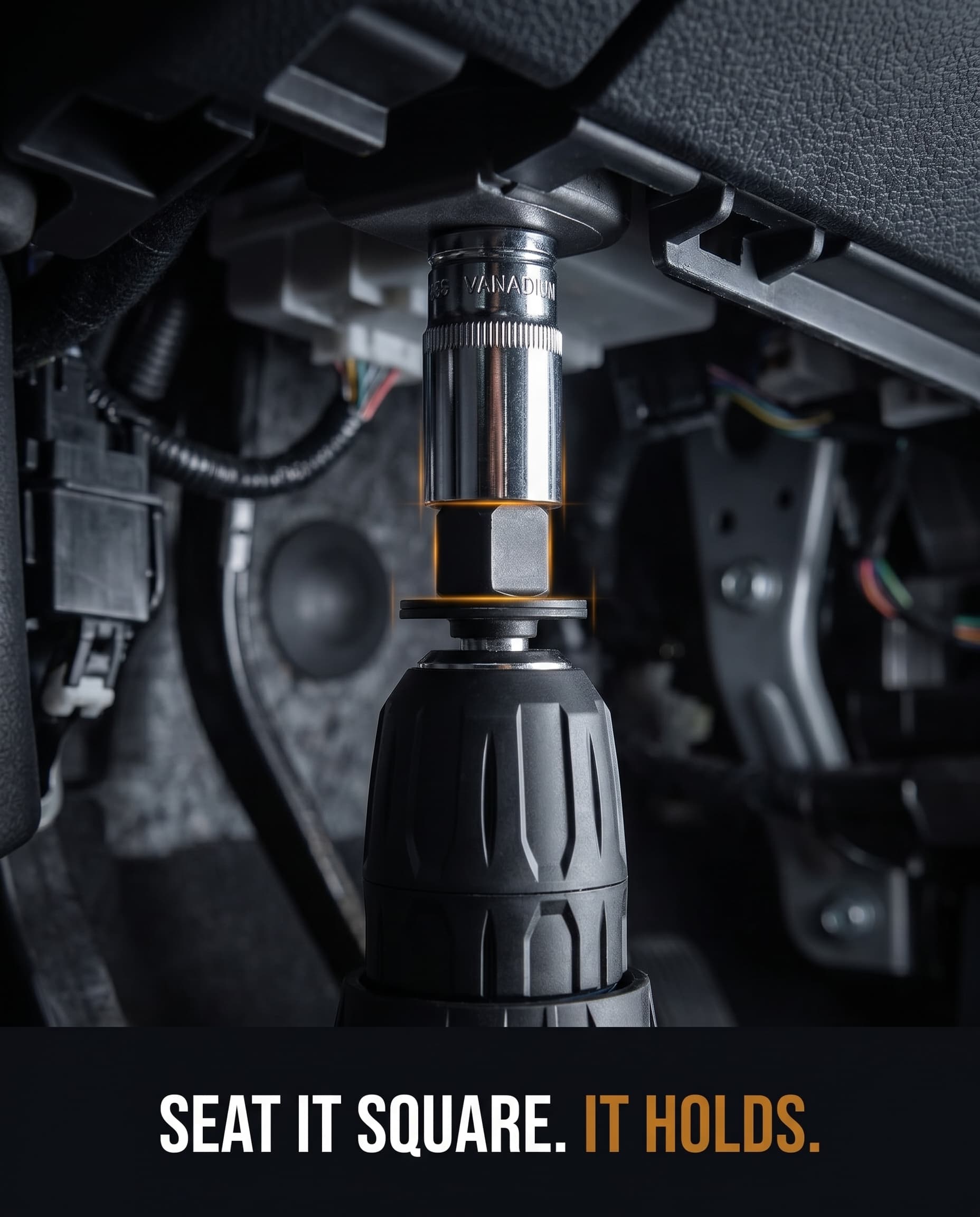
A strong magnet is built into every adapter to grip the socket and hold it firm through the hammering — no flimsy retention ring to wear out, no spring pin to drop and lose. Seat the socket square and it holds.
How strong is that magnet? Strong enough that when the adapters are nested together, they take a real pull to separate — that’s why a pry tool ships in the box. Some guys gripe about it on day one. But think about what it’s telling you: a magnet that grips the stack that hard is the same magnet holding your socket on when you’re upside down under the dash. We’ll take a set that’s a little stubborn to unstack over one that drops your socket into the bay.
Seat it square. It holds.
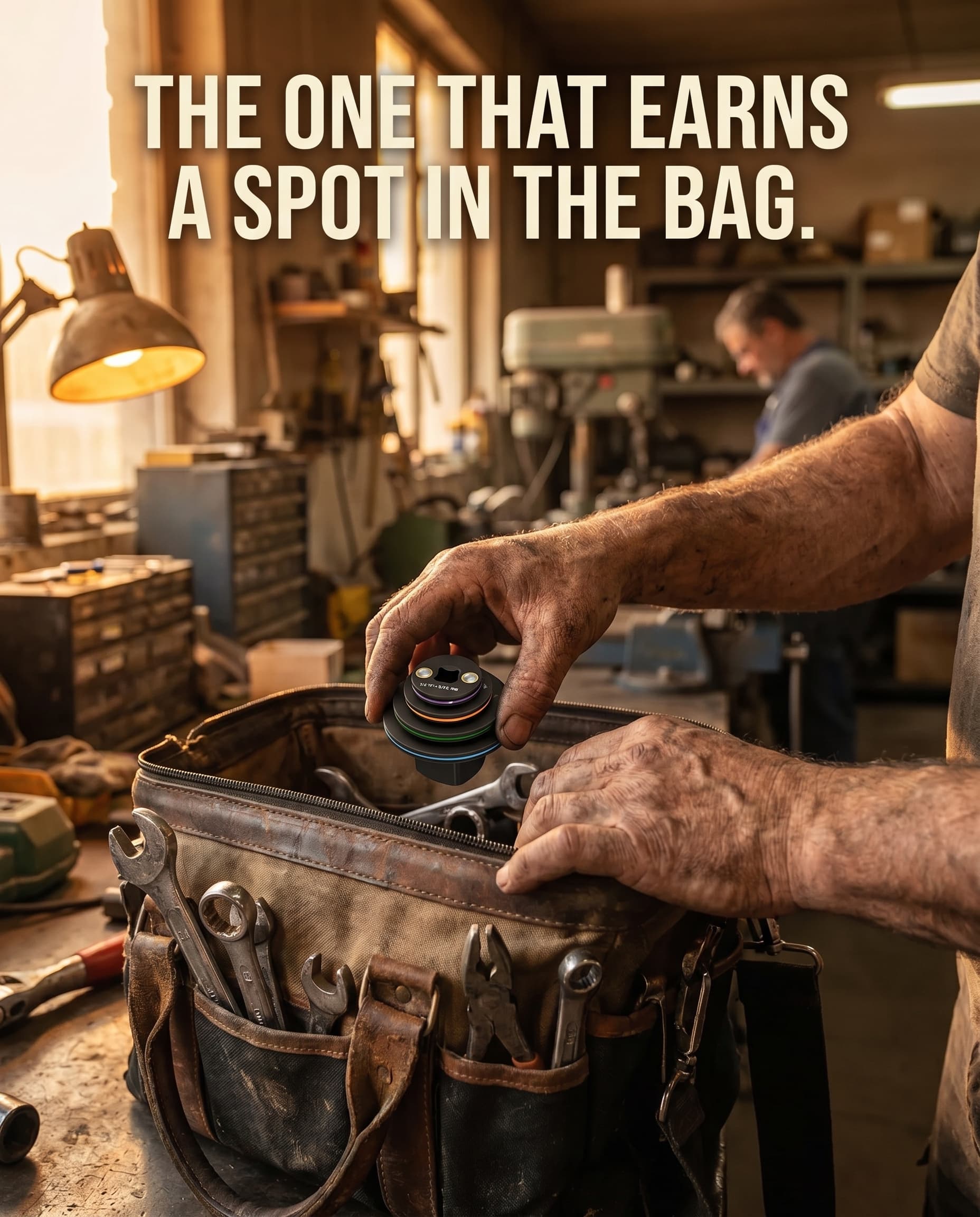
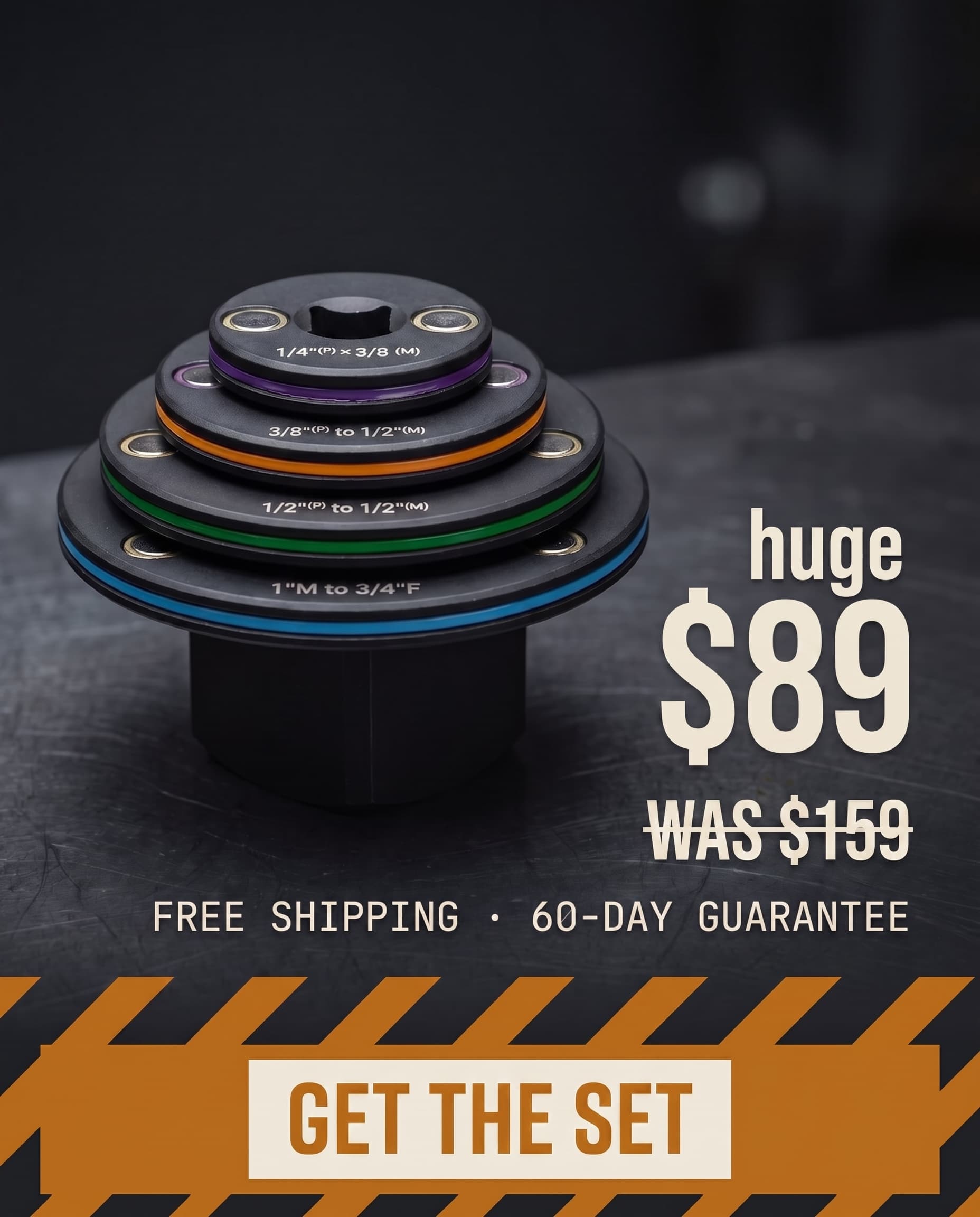
One compact kit covers the four conversions that do the most work — 1/4″→3/8″, 3/8″→1/2″, 1/2″→3/4″, and 3/4″→1″ — so you stop needing a whole drawer of tools just to change drive size. The adapters interlock and stack for compact, organized storage, so the set lives together in your bag instead of scattered across the bottom of the box. It even ships with a triangular pry tool tucked in.
One kit. Stacked and ready. Lives in the bag.
Forged and rated doesn’t mean “abuse it forever and physics stops applying.” Use the right drive for the torque you’re laying down — a small step-up still isn’t meant to carry a monster gun’s full output into a giant socket. Match the adapter to the job and it’ll outlast everything else in your box. That’s not buried in fine print. That’s just how steel works, and we’d rather tell you straight than sell you short.
We’re not going to insult you and say this is the last tool you’ll ever buy. Here’s the real math, against what you’ve already tried:
Break it down: that’s four forged, magnet-locked adapters for about what a single name-brand adapter runs you off the truck — and the only line on that list you buy once instead of again every time the cheap one snaps and every bolt it rounds. It’s not the cheapest adapter you can buy. It’s the one that stops being the part you keep replacing.
You shouldn’t have to gamble to find out if a tool’s any good. So don’t.
Put it on the gun. Lean on the worst, most seized fastener you’ve got. Beat on it like you’d beat on anything you actually trust. If it doesn’t hold up the way we told you it would, send it back for a full refund — that’s the 60-day money-back guarantee, no runaround.
The only thing you’re risking is the adapter finally not being the part that fails.
“This is something I always wished someone made — and finally found it.”
“I expect they can put up with serious impact torture despite being so low profile.”
“You’re getting 4 adapters for the same price you’d pay for 1 top name-brand adapter.”
“Well made, very thin, and incredibly durable. The price is better than I expected.”
“The steel material is plenty thick — great for high impact/stress situations.”
“A must-have for your tool bag.”
Aurisle™ Low-Profile Impact Adapter Set
Stop leaving snapped adapters in the bottom of your box.
Forge the link that finally won’t break.